The story in Melissa Harrison’s The Given World begins with Clare Grey, a middle-aged woman walking home with a sack of groceries. As she struggles up a long hill, she can’t think about anything going on in her life except the devastating news about her health. Clare lives alone in a converted Benedictine priory. It’s surrounded by an acre of gardens she tends with soulful reverence. On the terrace, there’s a sundial that a gardener, a former lover, once pulled from an old carp pond. On its face, he engraved the motto: Loyalty to the given world.
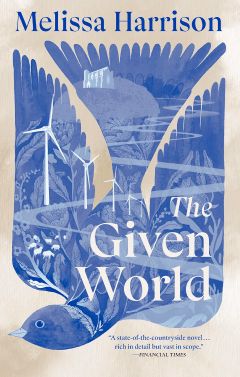
This richly imagined novel takes place over six months, from spring’s awakening to fall’s harvest. The setting is the fictional Welm Valley in southern England, a rural community where generations of farmers and village residents have spent their lives. These are colorful characters. They’re each equally strong in the dramatic circumstances of a strange, persistent disquiet. Things in their everyday life feel out of balance.
Angela Fairfax completes the interior design of the Old School House. She and her husband are London transplants, not natives of the ancient Welm Valley, where they’ve made their second home. The School House, dating back to the 18th century, now is the perfect cottage Angela envisioned, but instead of contentment and pride, she feels agitated. A boy almost drowns in the Welm River. Another boy clips an electricity pole while driving a combine; the pole leans on the cab, “black wires sagging.” And old Hilda Cantlow taking a long walk has the bad luck to fall into a pit of tangled foliage. She waits hours to be rescued and thinks about her life.
Oh, but what a terrible burden it must be to believe that you can choose and control everything, she thinks now; and she feels a great wash of loyalty to herself, and to the world around her, and she closes her eyes and smiles.
Connor Ailsby’s music creations have skyrocketed to success on Spotify playlists. He opted out of college, unlike his valley friends, and occasionally does odd-job work helping out on Piers Beaumont’s farms with his father. He misses the world he grew up in. Here’s someone so young already missing a not-that-long-ago past, a strong warning that a coveted way of life is noticeably, too quickly, changing. “It used to seem so real, so important, and now it’s like it’s fading away,” Connor thinks, the disquiet rattling his sense of safety and trust.
The characters’ inner lives are so eloquently expressed they cause a full stop by the surprise of it, and also by the relatability of their emotions. So many times I couldn’t continue reading without thinking about what I’d felt, what it meant.
Alan Jope’s farmland is the best in the valley, but he hardly has any of it left. He and his brother lost everything to Geoffrye Grey, Clare’s late father. Mr. Grey took the Jopes to court to prevent their plans to increase their neighboring farm into a mega dairy that would “utterly despoil” the area. He won. The Jope brothers had to sell land to pay their legal bills. Mr. Grey bought it for a pittance. Clare intends to right the wrong and return the land to Alan. Meanwhile, Hugh Tilbrook, the village’s retired doctor, is currently engaged with a legal but off-the-books housing development project. If it goes through, it will cut off service access to that Jope land, making farming it impossible. Tilbrook is the story’s villain, buying and selling farmland to turn a profit. He’s also a despicable womanizer.
Roy Leggett, Hilda’s nephew, wobbles, almost falls from Tilbrook’s house roof, which he’s repairing. He wonders if it’s a warning of some kind. A realtor is circling the area with a bloodhound’s nose. The greed and insensitivity in the air disturb everything, beating a steady pulse. It’s all connected, we’re told.
…while Piers Beaumont’s acres of wheat and feed barley look lush and golden, the grain in the ears is not ripening. The cuckoo has departed the valley unmated. He will not return next spring.
What happens when people no longer feel responsible for each other, let alone for the fields and meadows, the summer and winter birds, so much a part of their lives? What happens when progress darkens the promise of loyalty? A surprise consequence arrives in the conclusion with Alan Jope ringing the church bell. This is a profoundly affecting novel.
The Given World by Melissa Harrison is published by Biblioasis. A version of this review aired on WOSU’s Public Media NPR radio station WOSU 89.7 FM broadcasting in Central Ohio. Some edits were made for clarification in the transition of radio to print. Some elaboration has been added that could not be included in the radio review due to time limits.


Hi Kassie – Thanks as always for your excellent work. 🙂 Have a wonderful Thanksgiving! Michele (Smith) Willis
LikeLiked by 1 person
I hope you’re doing well, Michele. Happy Thanksgiving!
LikeLike
I very nearly read this on holiday but having read your review I’m glad I didn’t. I think it needs more attention and space than I would have been able to give it while away. Great review!
LikeLiked by 1 person
Thank you! It’s a wonderful novel.
LikeLiked by 1 person
I’m hooked! Next on my reading list. Thanks
LikeLiked by 2 people