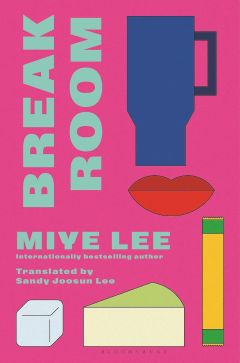
In the early pages of Miye Lee’s Break Room, a female employee chats with a coworker and learns a new hire’s salary is nearly the same as hers. Filming is taking place for a documentary about villainous behavior simmering beneath calm company atmospheres. The angry employee reacts by stuffing her pockets with break-room coffee packets and then stealing office supplies. Her actions appear in the documentary. Screenshots of her behavior go viral. Social media erupts, screaming foul for privacy invasion. Ratings for the documentary dive. The producer pivots to a reality TV competition called Break Room. It’s a blockbuster success.
Lee’s new novel is psychologically dynamic while also delightfully entertaining. That’s thanks to the vulnerable, observant narrator, who goes by the name Ice Cube. When called to join the TV competition, he’s shocked to find out he’s been selected for the show due to a survey, unknown to him, completed by his officemates. It asked them to vote for their worst office villain in the break room. From the Author’s Note to the novel:
It is one thing to be disliked, but being branded as unlikable without knowing the reason is its own kind of hell. The protagonist is left to endlessly dwell on the question of why, turning it over in his mind again and again.
The contestants come from different companies. Like Ice Cube, they are similarly shocked and also identified by nicknames. There’s Headphones, Gargles, Tumblers, Coffee Mix, Paper Cups, Monologue, and Cake. The narrator receives his moniker because he fills ice trays in his office’s break-room freezer with cola and coffee. Tumblers leaves his unwashed tumblers cluttered in a shared sink. Monologue goes on and on and on, speechifying instead of socializing and relaxing.
The contestants continue to work at their day jobs in private rooms. Down the hall is the break room, where they’re restricted to one hundred minutes a day. This is where they compete for prize money in the unveiling of a mole planted by the production team. The game works by earning hints. Bad behavior in the break room proves to be what rewards the contestants with said hints. Consequently, they hoard snacks, clog the sink, unplug the refrigerator, and generally behave like feral children. When Ice Cube hides in a cupboard and eavesdrops on Tumblers and Cake, he earns two hints, and with two hints, he can request information about himself. From the Author’s Note to the novel:
In this story, the characters react differently upon learning that they’re disliked. Some accept it, others have no idea why or simply don’t care. And some, despite not wanting to be hated, still somehow manage to make people hate them.
Ice Cube wants more than anything to know why something so innocuous as his silly habit causes his coworkers to ridicule and mock him behind his back. His concern gives the story reflective value. One day on the show, he finds himself detesting Coffee Mix. They had agreed to share their hints, and it appears she’s withholding from him. He realizes he needs to understand her conduct instead of react to it with quick-fire emotion. That is, if he’s to discern whether or not she’s the mole. In this moment of moral reckoning, Ice Cube says:
Never in my life had I tried to genuinely understand someone I despised.
When the mole is identified, it’s inconsequential to the overall purpose of the book, which is not about solving the mystery of the mole, rather dissecting the human propensity to judge and hate. As the novel concludes, recruitment for season two of the popular show has begun. Also, a mobile game based on the show is looking for beta testers. The list of nominated villains is endless. This is a swift read. The prose, written in a refreshing, undecorated style and a light tone, grabbed me and didn’t let go.
Break Room by Miye Lee is translated by Sandy Joosun Lee and published by Bloomsbury. A version of this review aired on NPR member station WOSU 89.7 FM broadcasting throughout Central Ohio.

 The Longest Chapter