
I introduced Jeremy Cooper’s novel Brian a while ago here on The Longest Chapter, eager to read it then but, as happens, left it waiting among the reading table stacks. But I believe some books “know” when the time is right to be read, as if stepping forward just when we need that one story or character or mood. Since I’ve already written about the book, I’m linking to that summary here. Let me just say, though, that Brian, the solitary, middle-aged protagonist who becomes a film buff, is memorably endearing. (“The sense of security experienced on noting the titles and times of a whole month’s movie bookings in his diary was immeasurable. It had never occurred to Brian that he might one day feel such contentment.”)

In Robert Seethaler’s new novella, his main character 30-something Robert Simon works in a bustling marketplace in Vienna, Austria. It’s 1966, and the capital city is poised for renewal and modernization. Simon, who lost both parents in the war and grew up in a home for orphans, rents a room from a war widow who offers him companionship and advice. When he notices an abandoned café on a nearby corner, he signs the lease and reopens it. Here all kinds of personalities gather, from the beefy entertainment wrestler to the promiscuous painter and his furiously jealous girlfriend (the marketplace cheesemonger); from the card player who teases people with his glass eye when he’s drunk to the flirty old woman picking up men. The wonder of The Café With No Name (translator, Katy Derbyshire) is how it makes you want to keep reading, when nothing dramatic really happens. Yes, the furnace blows up and Simon has to kick out a disruptive, troubled young man, but these incidents play out as part of daily café life. Happiness comes easily to Simon, who finds it in his work, companionship, and community. It’s enough for a good life. This is a gentle story. Hopeful, too. Whenever Mr. Seethaler publishes a new book, I’ll be in line for it.

Here’s the long-awaited follow-up to The Bright Forever, a novel by Lee Martin that was a finalist for the 2006 Pulitzer Prize in Fiction. The Evening Shades is described as eloquent and quietly moving, as well as gorgeously written and suspenseful. The story takes place in 1972 when a stranger rents a room from a lonely old woman in Mt. Gilead, Illinois. From the description:
It is risky—she doesn’t know anything about him. But Edith Green can no longer bear a life lived alone. And Henry Dees is haunted by the past he carries with him from another small town, particularly by the death of a little girl that some people think was his fault.
Given Martin’s gift for evoking the rich singularity of small midwestern towns, and his keen insight regarding the hearts and minds of the inhabitants, this promises to be rewarding, a story to indulge in and remember.
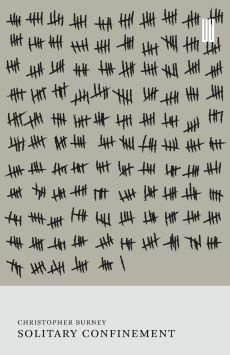
Solitary Confinement by Christopher Burney first appeared 40 years ago. According to the publisher that’s bringing it back into print, this book of nonfiction has quietly developed a reputation as a modern masterpiece of contemplative literature. Here’s the description:
Parachuted into France as a British secret agent, Christopher Burney was arrested by the Gestapo and thrown into a solitary confinement cell in a prison outside Paris. There he spent 526 days in complete isolation. With little human contact and nothing to distract him, Burney developed a mental and spiritual regime that enabled him not just to survive but to develop an internal resilience that enabled him to survive his subsequent time in Buchenwald concentration camp.
This reintroduction of the book is due to the exceptional work by Boiler House Press in its Recovered Book Series. The series includes books I’ve written about here, and praised, including Gentleman Overboard by Herbert Clyde Lewis and No More Giants by Joaquina Ballard Howles. I’m eager to read Christopher Burney’s recovered book, a new discovery for me.

Abdulrazak Gurnah has a new novel Theft out this week, his first since winning the Nobel Prize in Literature in 2021. The focus is on three young people — Karim, Fauzia, and Badar — who come of age in Tanzania at the turn of the 21st century dreaming of great possibilities, so says the description. Except for Badar, an uneducated servant boy, “it seems as if all doors are closed.” He finds friendship with Karim, the young man of the house where he works. Also with Fauzia, who sees the potential for escape via Karim from a smothering upbringing. From The Guardian, which says the story “keeps us on our toes:”
Meanwhile, sketched between the lines, is family heartache spread over several generations, all narrated in a quicksilver style that gives you the pleasurable sense that you’re putty in the hands of a warm yet clear-eyed authorial intelligence.
The two stick by Badar when he’s falsely accused of a theft and sent away from the house. Reading there’s betrayal and a happy ending — “ultimately cathartic,” according to The Guardian — gives me the sense this is an intriguing new novel by a Nobel laureate in fiction.

 The Longest Chapter
Seethaler is so good at portraying the everyday, isn’t he. I can vouch for Theft which I reviewed on my blog today. Another eloquent yet understated novel from Gurnah.
LikeLike
Good to hear this about Theft. I’m eager to read your review.
LikeLiked by 1 person