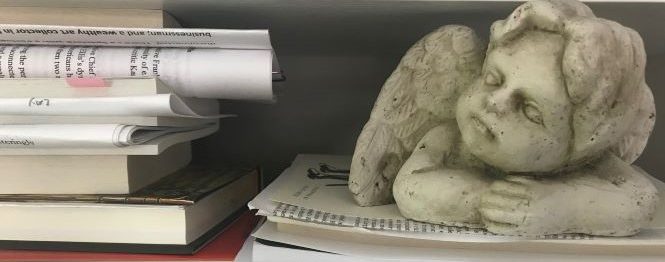
This is a mixed bag of selections. They are books I’m reading and ones I’ve ordered. Please don’t overlook the poetry. April is National Poetry month, a time for everyone to choose a poet or a poem or a collection of poems that may become a go-to, the folded poem in the wallet or the book always in the knapsack, purse, or briefcase to turn to for inspiration and hope.
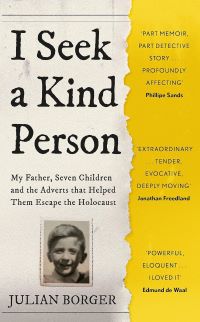
I Seek a Kind Person by Julian Borger
Last month, I read a review of this family memoir in the Times Literary Supplement. I’ve purchased it from Foyles, a London bookshop I frequent online, as it’s not available from a US publisher. The author Julian Borger is world affairs journalist at the Guardian who knew little about his father Robert’s experience as a Holocaust survivor (or “survivor,” as the review prints it), but his father’s death changed that. The memoir tells of adverts in the Manchester Guardian newspaper in 1938 where Jewish families living in Vienna advertised for their children to be kept safe in the homes of British readers. The advert for Robert read: “I seek a kind person who will educate my intelligent boy, aged 11, Viennese of good family.” I Seek a Kind Person intrigues me for its story about families at risk relocating their children during World War II — the realities beyond the knowledge that it was something that happened — the tactic of the adverts, and a seasoned jounalist’s research.
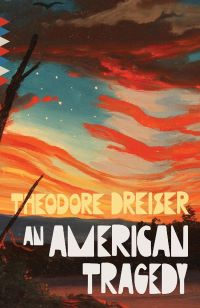
An American Tragedy by Theodore Dreiser
The Atlantic has published a new list of Great American Novels. The magazine describes its effort as bringing together the most consequential novels of the past 100 years, 1924 to 2023. There are 136 on the list. An American Tragedy is one of them, the novel that brought Dreiser recognition after his debut Sister Carrie, followed by Jennie Gerhardt and other novels. Penguin Random House features a page with 79 of the novels on The Atlantic list that they publish. The summary of their Vintage Classics edition says: “Theodore Dreiser was inspired by a true story to write this novel about an ambitious, socially insecure young man who finds himself caught between two very different women—and two very different visions of what his life could be.” I read Sister Carrie during my college years, and I found Jennie Gerhardt in a used bookstore (I loved it), but I’ve never read this one. If you’re interested in The Atlantic list, you’ll need a subscription, or you can sign up for a free trial on their website. (Here’s the link.) Or visit the 79 novels at Penguin Random House here.
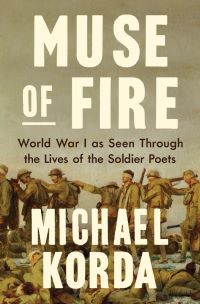
Muse of Fire: World War I as Seen Through the Lives of the Soldier Poets by Michael Korda
Author Michael Korda might be familiar for his biographies of Ulysses S. Grant, Dwight D. Eisenhower, and Robert E. Lee, as well as his memoir Charmed Lives. But when I read about Muse of Fire, I thought first of Pat Barker’s Regeneration Trilogy, three novels about World War I whose characters include poets Siegfried Sassoon and Wilfred Owens. If you haven’t read the trilogy, you must add it to your reading table. (Ghost Road, the third book in the trilogy, won the 1995 Booker Prize.) Korda’s new nonfiction comes at the war from several poets’ lives “who came to describe it best,” according to the book’s description. It also says: “…the poets of the First World War were soldiers, heroes, martyrs, victims, their lives and loves endlessly fascinating―that of Rupert Brooke alone reads like a novel, with his journey to Polynesia in pursuit of a life like Gauguin’s and some of his finest poetry written only a year before his tragic death.” I have high hopes for this one.
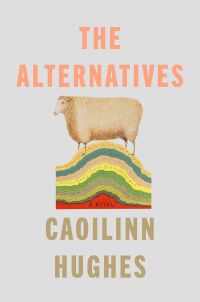
The Alternatives by Caoilinn Hughes
Here’s a story of four sisters in a family drama by one of Ireland’s talented contemporary authors. I’m a big fan of Irish literature (authors Kevin Barry, Claire Keegan, Donal Ryan, Louise Kennedy come to mind) so want to include this new novel, even though it’s going to be a while before I get to it. From the book’s description: “The Flattery sisters were plunged prematurely into adulthood when their parents died in tragic circumstances. Now in their thirties—all single, all with PhDs—they are each attempting to do meaningful work in a rapidly foundering world. The four lead disparate, distanced lives … until one day their oldest sister, a geologist haunted by a terrible awareness of the earth’s future, abruptly vanishes from her work and home.” I’ve read lots of praise for The Alternatives. I’m intrigued.
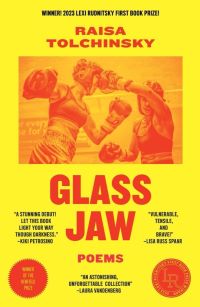
Glass Jaw: Poems by Raisa Tolchinsky
Poet Raisa Tolchinsky contacted me for possible review coverage of her new, prize-winning collection. I enjoy reading poetry and discovering new poets, but I typically decline requests as I’m not qualified to review poetry; however, there’s always the possibility of writing about it or sharing it on the talk show. I found the topic of Glass Jaw irresistible: women’s boxing based on the poet’s time training as a fighter in New York City. So I said yes. I’ve been reading it slowly this month to take it a bit at a time, this world Tolchinsky brings to us with stunning power. She writes inside, beside, and outside the ring. From “Carmen [You’re a Woman Until You Spit Twice in the Bucket]” :
They want you crying in the corner like a still-life– / a vase, / a bonnet, / a little bird.”
How else except from a poet to get this palpable sense of a woman in such a masculine environment? Or what she feels in her body? Here’s this, from “Canto 12 Stones, Which Oftentimes Did Move Themselves:”
If she steps left when she should / have stepped right, an uppercut / to the low belly opens an aching bin. / What is the division / between a body and the rest of its life?
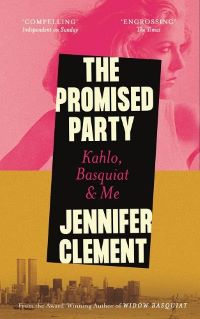
The Promised Party: Kahlo, Basquiat & Me by Jennifer Clement
This memoir from the author of Widow Basquiat: A Love Story is described as a tale of two cities and their artists, from 1970s Mexico City to 1980s New York. In Mexico City, Clement lived an “unorthodox and bohemian” childhood next door to the Mexican painter Frida Kahlo and later became immersed in New York’s eighties counter-culture “frequenting The Mudd Club, Danceteria and Studio 54,” according to the description on my copy. The chapters are written in the currently popular shortness of a couple pages, a style I at first snarled at (versus my favor of the long narrative form). I’ve become accustomed to it, though, and enjoy this new way of writing. As for The Promised Party, I’m nostalgically drawn to it because of the artists and the decades, a time I love to revisit, when I was much younger.

 The Longest Chapter
such an “intriguing” selection. I want to read all of them, especially Glass Jaw and I Seek a Kind Person, if only for its title. Thank you.
LikeLiked by 1 person
Thanks for highlighting All for Nothing a few weeks back. Oh my! Just what I needed after reading way too much “entertainment” versus enlightenment. Now I’m intrigued by I Seek a Kind Person, if I can find. I read various book reviews, but you are my true north. Keep up the fine work!
LikeLiked by 1 person
Thank you Mr. Turner for your kind comment. I hope you’re successful in your pursuit of Julian Borger’s memoir. And I get it, how reading entertainment books sometimes needs a break!
LikeLike