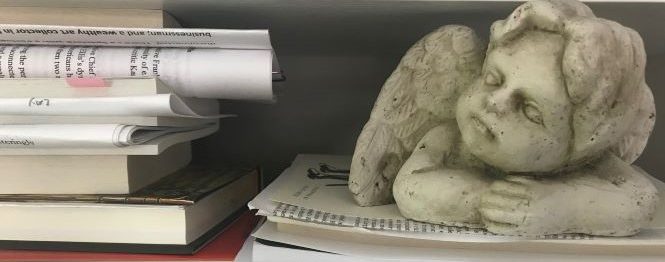
Evelyn Harter Glick worked in design and production for three of William Faulkner’s publishers in the early and mid-20th century: Cape and Smith, Smith and Haas, and Random House. During this time she designed eight Faulkner books, from As I Lay Dying through Absalom, Absalom! In 1979, she gave an interview to James B. Meriwether, whose name I recognized from Faulkner biographies: Meriwether identified discrepancies between The Hamlet, The Town, and The Mansion, a trilogy Faulkner didn’t intend to be a trilogy, but then it turned out all three followed the Snopes family. Meriwether is most notably known for his bibliographical expertise on Faulkner’s body of work.
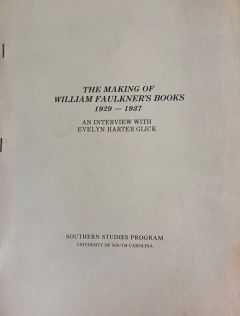
This stapled transcript of the Glick-Meriwether interview recently joined my personal Faulkner library. It’s 57 pages packed with details about publishing The Sound and the Fury (1929), As I Lay Dying (1930), Sanctuary (1931), Light in August (1932), and Absalom, Absalom! (1936). Reading it brings to life the days when publishing houses were actually houses, not office buildings, such as a NYC townhouse where for Cape and Smith Glick’s office was in the kitchen. Small, passionate staffs worked closely, running up and down the staircase, sharing responsibilities, jumping in where needed with opinions and copyedits, and working with spontaneity. Glick comments on the times having changed since working on the Faulkner novels, that being the loss of intimacy in publishing, the love of the books, the connections with authors — comments that feel relevant today even though her interview took place almost five decades ago.
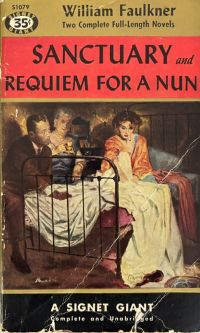
Much of the transcript involves questions/answers about binding, galleys, and setting type but also wonderful anecdotes, such as when the manuscript for Faulkner’s Sanctuary arrived at Cape and Smith. Publisher Harrison (Hal) Smith said to Faulkner, “Good God, I can’t publish this. We’d both be in jail.” If you’ve read Sanctuary, you’ll know why. Joseph Blotner writes in his acclaimed Faulkner biography that two major responses to the novel were “horror at its subject matter and grudging admiration of its power.” *
Cape and Smith put it aside and focused on getting As I Lay Dying out the door. They next took a gamble and proceeded to publish Sanctuary. It’s no secret that Faulkner wrote the controversial novel as a deliberate attempt at a bestseller. Hence, deciding to publish the potboiler might have been economic need during the Depression. Cape and Smith proceeded into galleys, without touching base first with the author. Faulkner rarely if ever reread his books, but this time, he did. From Meriwether:
When As I Lay Dying was finished, [Cape and Smith] completed the setting of type for Sanctuary and the first thing Faulkner knew about it was when he got the galleys. And that was when he did the big job of revising [Sanctuary] in galley proof with the horrendous printer’s bill for all those alterations.
Everything worked out upon publication. Sanctuary was the first Faulkner novel to make money for Cape and Smith.
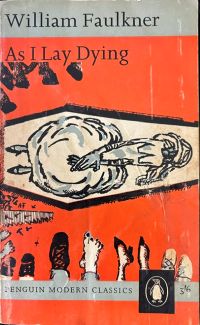
For a long time, I’ve had a curiosity about Faulkner’s life and work, which started when I received a letter in 1978 from Meta Carpenter Wilde, whom Faulkner met in Hollywood. (You can read about that letter here.) It’s a messy curiosity, i.e., I have more books by and about Faulkner than I’ve read, even in different languages, and I collect first edition paperbacks that once hung out on dime store revolving book racks (mostly for the interesting illustrations). As for the interview, details behind publishing efforts, such as instructions not to put apostrophes in Faulkner’s one-syllable contractions and how the map got tipped into Absalom, Absalom!, fit into this crazy curiosity of mine.
If you do an online search for which Faulkner novels to read, or which one to read first; or if you search for the top five or the top 10 to read; or if you ask Google why you should read them at all and in what order, you’ll find plenty of recommendations. I gave it a shot myself in a blog post long ago that still consistently gets quite a few hits. Now, I’m not sure there’s one right answer; however, The Portable Faulkner might be the way to go.
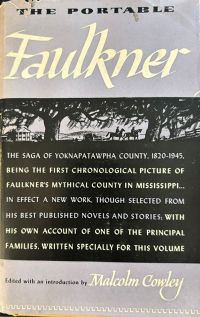
In 1946, Viking Press editor Malcolm Cowley pulled together this compendium of excerpts to bring into more accessible light Faulkner’s complex characters, stories, and fictional Yoknapatawpha, Mississippi. Something had to be done to salvage his work. All of Faulkner’s books were out of print at the time, except Sanctuary. Cowley’s anthology included excerpts from The Hamlet, Sanctuary, Absalom, Absalom!, The Sound and the Fury. The cover of the book’s first edition gives a nice summary overview:
The saga of Yoknapatawpha County, 1820-1945, being the first chronological picture of Faulkner’s mythical county in Mississippi…In effect a new work, though selected from his best published novels and stories; with his own account of one of the principal families, written specially for this volume.
The Portable Faulkner was part of The Viking Portable Library Series, books designed to be held and carried easily and conveniently. Faulkner’s is famously known as the catalyst that paved the way, finally, to popular recognition of his literary mastery and genius. He was awarded the Nobel Prize in Literature three years later in 1949.
*Faulkner: A Biography one-volume edition by Joseph Blotner. Random House 1984, pages 239 and 275.


Great post, I’m a big Faulkner fan
LikeLiked by 1 person
Thank you, and glad to hear from a fellow fan.
LikeLiked by 1 person
Thanks for this, long been a fan, starting in my 20’s when I read his works and nothing else for several weeks. Now 40 plus years later I started back in. Better than ever!
LikeLike
I’m starting back in myself, although my journey was a bit different than yours, much of my reading of his novels first in college. Then the fascination with Faulkner’s life and reading several biographies, plus visiting Rowan Oak, twice. Now, back to the novels, especially the ones I haven’t read yet.
I hope you enjoy your return to Yoknapatawpha County!
LikeLike