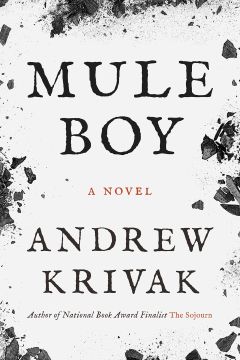
In Pennsylvania coal country, 1929, the morning of New Year’s Day, Slovak immigrant miners wait for the cage to take them below. Thirteen-year-old Ondro Prach is among them. Five years ago, his father died in the mine, so he knows its peril. Even so, Ondro has grown to love the depths of the earth, working first as a nipper and then a spragger. Today he begins a new job as the mule boy, leading the animal that pulls carts through the tunnels. Today also will be marked in history as the New Year’s Mine Disaster — a roof caves in trapping Ondro and four other miners. The tragedy provides dramatic heft with a page-turning question of how Ondro alone survived. He narrates the story as an old man whose mind turns back to that day, “again and again,” triggered by a sound or something seen.
This is not a story of the mine collapse alone, but equally of Ondro’s life thereafter. The two masterfully interconnect, woven together in elegiac prose written without periods. The grammatical absence is neither experimental nor distracting. It’s storytelling at its finest, immersing us with rhythmic perfection in Ondro’s remembering and his burden of fear and guilt.
Not long after the calamitous event, Ondro and his mother leave the mining town to escape the suspicious, grudge-bearing families. Ondro gets into fights with school boys who taunt him with sick jokes about the tragedy. One day, so enraged, he breaks the bones in a boy’s face.
Years later, Ondro drops out of college and works at a brewery. He gets romantically involved with the daughter of one of the four miners who died. He types letters to her at college, telling Magda he’ll wait for her to graduate. When she does, they marry, but the marriage doesn’t last. It’s not a surprise to them. Ondro’s withdrawn and often drunk. He works nights. Magda works days.
Ondro ends up in prison for refusing to be drafted into the military during World War II. The reason links back to the childhood violence he experienced as the mule boy who survived. Ironically, prison is where he finds his freedom. It’s because of Jacobson, a fellow prisoner who teaches Ondro the story of the prophet Jonah, from the Book of Jonah, and the wisdom of Greek philosopher Parmenides.
To read what Ondro learns from Jacobson is to read the truths of memento mori, the reminder that we must die. It far surpasses the function of a plot element, reaching into the ordinary person’s mortal fear of the unknown. Indeed, here is a meditation on the complete absence of light — in the tunnels of a coal mine and in death — with extraordinary discernment and understanding drawn from the meaning of eternity.
Ondro works as a forest ranger in New Hampshire after prison. In his retirement, the children and grandchildren of the miners lost long ago find him. He’s ready for their questions. Ondro understands his significance as their messenger. Even Magda arrives. Ondro shares details about her father that he never spoke of when they were married. This is when we finally learn how the mule boy survived. There’s much to love in this novel. It’s a rare gem and an utterly unforgettable reading experience.
Mule Boy by Andrew Krivak is published by Bellevue Literary Press. This review, aside from minor edits in transition from radio broadcast to print, was heard on Ohio’s NPR member station WOSU.

 The Longest Chapter
Thanks for bringing Krivak back to my attention, I read The Sojourn years ago and meant to follow his career. I did read The Bear also, but didn’t impact me the way of Sojourn. This one sounds like he is in top form.
LikeLiked by 1 person
He is in top form.
You’ll be swiftly taken in, and astonished at all that happens.
LikeLike