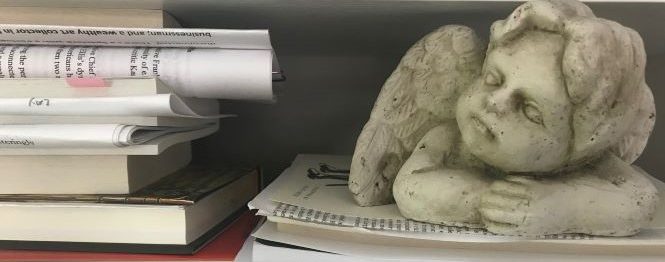
William Boyd won my literary love with his novel Brazzaville Beach and later Any Human Heart. So, I was eager to read his new novel, Gabriel’s Moon. The protagonist, Londoner Gabriel Dax — a 30-something travel writer who drinks lots of whiskey, smokes French cigarettes, and loves his independence — happens to be on assignment in Léopoldville, the capital of the then newly independent Republic of the Congo. It’s 1960. Thibault N’Danza, an old friend from university days, the Minister for Health in the Republic’s new government, offers Gabriel the opportunity to interview the country’s prime minister, Patrice Lumumba.*

Gabriel records the interview, as requested by Mr. Lumumba, and while this appears to be the chance of a lifetime, Gabriel finds himself caught in alarming situations involving MI6. People want the tapes. Complexities roll in, and dark ambiguities pile up, but the story maintains a light touch, due to Gabriel not being a true spy, at heart still a travel writer who just wants to write his new book. No matter how many times he tries to remove himself from increasing danger, he still finds himself agreeing to the demands of MI6 agent Faith Green, whose charms he can’t reisist. Boyd keeps us perplexed, right along with “the useful idiot,” as Gabriel refers to himself, until the very satisfying and smart conclusion. *In history, Patrice Lumumba was the first prime minister of the Democratic Republic of the Congo. That was June through September 1960, a short term because he was assassinated. This figures into the novel’s plot.
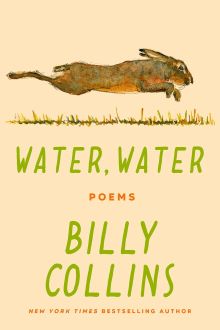
Billy Collins has released a new poetry collection this month. The dust jacket illustration alone makes it desirable, at least for me, calling to mind Richard Adams’ 1974 bestselling novel Watership Down. (Oh how I loved that book!) Once again, this former Poet Laureate of the United States creates magic in verse, insights from his everyday life, both wise and humorous, always keenly observant. Among the 60 poems, here are a few titles: “Cough Drop” (about experts who know exactly what to do), “BC/AD” (about an out-of-control class discussion), “Deep Time” (about an argument with his wife — and he’s digging his heels in), and “Doctor Jesus” (too funny to summarize). Let me tempt further with this opening verse from his poem “Fire:”
I’m having a swell time reading Lonesome Dove,
Glad I still have 400 pages to go,
But this paperback is one
Of a thousand things around me
I would not grab as I dashed into the street
If the house ever decided to burst into flames.
It ends with what he’s holding while standing out on the lawn, in a bathrobe, as firefighters rush past him. Billy Collins writes with “trademark lyrical informality,” as written on the dust jacket flap, and that’s much of his appeal. Water, Water is a joy to read.

Jonathan Littell’s new book of nonfiction, co-authored with photographer Antoine D’Agata, is a combination of war reportage and interviews with personal, philosophical, and historical reflections. That description comes from a review in the Times Literary Supplement (TLS), which is where I first read about An Inconvenient Place. Littell completed the first version of the book, which was focused on Babyn Yar (also known as Babi Yar), in February 2022. It was two days before Russia invaded Ukraine. Littell writes: “…the text I had written became entirely irrelevant.” He changed his approach.
To speak about Babyn Yar no doubt still has meaning, but no longer the same one.
There still is much about Babyn Yar in this book, so it was not completely abandoned, rather remains part of what became a broader perspective. For those who don’t know, Babyn Yar is the site of an unimaginable World War II atrocity, where in 1941 Germans massacred hundreds of thousands of Kyiv’s Jews in a ravine near the capital city. An Inconvenient Place explores how and why traces of atrocities get erased — the ravine filled in and the land built over, transformed into offices, apartment buildings, shops, schools, a metro, and a park. There are Holocaust memorials, but they feel occasional and scattered. The book begins with Babyn Yar, and then Littell and D’Agata leave Kyiv for nearby Bucha, where present-day atrocities occurred by Russian occupying forces. These, too, now erased with rebuilt homes, repaved roads.
The narrative is written in a succession of numbered entries that, along with D’Agata’s profound and moving photography, capture the flow of Littell and D’Agata’s days: what they see and whom they speak with. Powerful is the way Littell pulls their findings and experiences together with Ukraine’s complicated past. I don’t typically like to read books concerning what I’m reading in my daily news, in this case the Ukraine war, but this book irresistably called out to me, and I found it fascinating.
An Inconvenient Place, translated by Charlotte Mandell, is published by Fitzcarraldo Editions, recognizable for its blue-white paperback books with French flaps. Fitzcaraldo was written up in The New Yorker last July (you can read it here). The TLS review about An Inconvenient Place is available here.
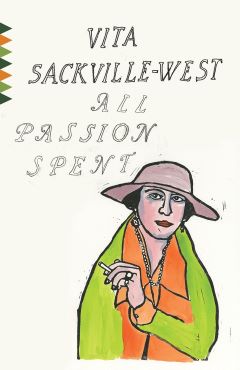
Finally, I’m halfway through this best-known novel by British author Vita Sackville-West, published in 1931. I’m enjoying the premise of an 88-year-old woman newly independent, after the death of her husband, whose presence dominated her life. Henry Lyulph Holland, first Earl of Slane, was a former prime minister of Great Britain and viceroy of India. Mere days after the funeral, Lady Slane’s condescending adult children plan for her to live with them, but Lady Slane has found a house to rent in Hampstead. They’re shocked. “Such a hint of independence was an outrage, almost a manifesto,” Sackville-West writes. Since I’m only halfway through, I’ll provide headlights from the novel’s description:
[In Hampstead], to her offspring’s utter amazement, [Lady Slane] revels in her new freedom…and gathers some very unsuitable companions—who reveal to her just how much she had sacrificed under the pressure of others’ expectations.
It’s a small book of only 169 pages (Vintage Classics/Penguin Random House edition), engaging for the variety of quirky, stuffy, arrogant, kind characters, and the thoughtful way Sackville-West captures Lady Slane’s transition. All Passion Spent was made into a TV mini-series in 1986 by the BBC.

 The Longest Chapter