Six fishermen prepare to head out for a day’s work. Among them is our protagonist, an unnamed boy, and his dear friend Bárður. They carry supplies, baited lines, and rigging to the boat. All of a sudden, Bárður rushes back to the hut where they live. He wants to memorize lines from John Milton’s Paradise Lost, so he can recite them during the long, hard slog ahead. Bárður and the boy love books and poetry. This last-minute decision distracts him, and Bárður leaves behind his waterproof.
It’s the turn of the 20th century, in a remote Icelandic location where for thousands of years men from the age of 13 became fishermen. Our narrator in Jón Kalman Stefánsson’s magnetic Heaven and Hell is an unusual collective voice, a chorus of those who drowned at sea. They speak with inviting wisdom.
Dark clouds gather. Spare words and lyric sentences pulse a threat. Raging waves and blinding snow soon punish the wood boat. It’s not a spoiler to tell you that Bárður — without his waterproof, drenched and frosted — freezes to death. That’s the tragic event igniting and expanding into the story’s power and significance, a reckoning of friendship, books, and the sea that swallows lives. Back on solid ground, the grieving boy plans to return Milton’s fatal book to the man in the village who lent it to Bárður. Then he’ll take his despair into the wilderness and let the snow cover him forever. But the village is a world of resilience far from the murderous sea.
The narrating spirits introduce us to its colorful residents, including the once drunk-and-philandering reverend, now clean and forgiven; sibling carpenters who built a village school with their own money; and a wealthy businessman who remarried late in life to an arrogant, cold younger woman. She’s the one who saves the boy, giving him a place to stay and a job. That job is to watch over two old sea wolves who hang out in her kitchen. One is the captain of a ship called The Hope. He’s known for having withstood all the raging weather of the sea, laughing in the face of the terror, shouting with delight, some have said. The other one, a now blind captain, owns a library of 400 books, including the borrowed Paradise Lost. Poetry and the sea alone matter to him. The boy becomes his reader.
Some novels are so extraordinary, it’s hard to do them justice in a review. This is one of them, remarkable for its alluring articulation of the daunting arctic weather, and the hovering uncertainty that’s so bound up within it. Also, the bewitching reflections of the otherworldly ones, speaking about life and death during this long-ago time. Now among them, a ghostly Bárður calls to the boy in the last pages. Stronger, though, is a pull of purpose emanating from those two boorish, old sea wolves at the kitchen table and the irrepressible woman who opens her door to them and the boy.
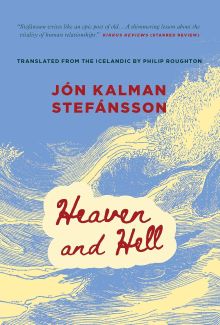
Heaven and Hell by Jón Kalman Stefánsson is translated from the Icelandic by Philip Roughton and published by Biblioasis. This review originally aired on NPR member station WOSU 89.7 FM, broadcasting throughout Central Ohio.

 The Longest Chapter
One thought on “A powerful story about books, friendship, and despair”