
It happens every December. There’s a new book I passed by from earlier in the year that keeps tapping at the must-read door. Only this year, there are two, one fiction, the other nonfiction. The former I recommended during our December show of All Sides Weekend Books because I’d finally made time to read it: Ben Shattuck’s collection of interrelated stories, The History of Sound.

The collection spans three centuries in time, populated by memorable characters, from the 1700s to the present day. Each story, set in New England, has a pair, with one illuminating a richer depth in the other. They are warm-hearted, satisfying in their originality and deeply thoughtful. In one story, a couple approaches a farm on Nantucket where they stay the night with a young man and his mother. The son inspects the satchel of the visiting man, while everyone sleeps at night, and discovers a connection to his mother. The man, an artist, leaves behind a small painting of a bird, after he leaves with his wife. Centuries later, the painting appears in a house on Nantucket, a small part of a larger story. This book has turned out to be one of my favorites read in 2024.

The other insistent one, the nonfiction, came in the mail from the publisher in the fall, and when I saw the title, I assumed it wouldn’t be for me, history that might be enjoyed by a select few. And yet, that “you must read this” whispering every time I shifted it when rearranging my books. So here I am in the last week of the year still wanting to read it. For what it’s worth, this happens because there are so many books published every year, how do I choose? Let me also say that every time I leafed through The Notebook: A History of Thinking on Paper, I landed on a fascinating story. Consider this one, the night in August 1661 when Nicolas Fouquet, “the richest figure of the French court,” Superintendent of Finances for Louis XIV, “threw one of the most lavish housewarming parties the world had ever seen.”
The night marked Fouquet’s confirmation as the king’s leading subject. With profound satisfaction he had watched the cream of society roam the landscaped grounds … Their stupefied smiles were worth every penny of the enormous expense, and he was relaxed as they capered from room to room, bumping into furniture, spilling wine, vomiting discreetly. Nothing that truly mattered would be damaged. His most valuable possessions were safely out of sight. These were not jewels, nor paintings, nor furniture: they were nothing to look at – just a pair of large black scrapbooks filled with notes and letters.
Two weeks later they would bring him down.
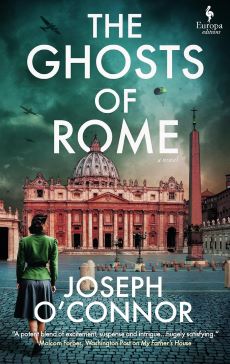
I’ve noticed Joseph O’Connor is bringing out the next installment of his World War II story about Monsignor Hugh O’Flaherty and The Choir. This is the second book in The Rome Escape Line Trilogy based on a true story of an underground network that smuggled escapees out of Nazi-occupied Italy. I loved Book One, My Father’s House, (you can read what I said about it here) and have high hopes O’Connor will continue with his moving in-depth storytelling and suspense.
In The Ghosts of Rome, the drama begins with a wounded Allied airman taken in by The Choir and desperately needing medical attention. Intensifying the plot is SS Commander Paul Hauptmann’s orders to shut down the network or face the Führer’s wrath — Hauptmann’s family in Berlin is being watched, as a motivating threat. In its early review, Kirkus Reviews writes: “This well researched novel can stand on its own, but readers may find even more enjoyment reading My Father’s House first.” Kirkus also describes it as “Top-notch storytelling filled with emotion and drama.” I’ve also read others describing the novel as unputdownable and pulse-pounding. Its current release date is February 4, so there’s time to read Book One.

 The Longest Chapter