Next month, 16 years after The Story of Edgar Sawtelle became a bestseller, David Wroblewski’s new novel will be released. All these years, I’ve wondered if Wroblewski would write another novel, and then what feels like out of the blue, here it is: Familiaris.
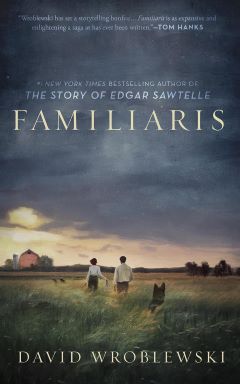
Familiaris takes place fifty years before The Story of Edgar Sawtelle, which (a quick recap) is about a mute boy and a family that breeds a one-of-a-kind lineage of dogs. Edgar believes his uncle, now married to his mother, murdered his father (think Hamlet) and runs away with three of the dogs. Now, Wroblewski is focused on Edgar’s grandfather, creator of the unique Sawtelle breed. I love what the forecasting literary magazine Kirkus Reviews writes about Familiaris:
For all the eons it may take to read it, this colossus of a book will own you.
It’s just shy of 1,000 pages; and yet, I’d say it’s better to be owned by a book instead of a cell phone, streaming shows, or a bazillion lists. Here’s more from the novel’s description:
Familiaris takes readers on an unforgettable journey from the halls of a small-town automobile factory, through an epic midwestern firestorm and an ambitious WWII dog training program, and far back into mankind’s ancient past, examining the dynamics of love and friendship, the vexing nature of families, the universal desire to create something lasting and beautiful, and of course, the species-long partnership between Homo sapiens and Canis familiaris.

Paul Auster died April 30, the author of Timbuktu, a novella about the homeless Willy Christmas and (keeping with the dog theme) his canine companion, Mr. Bones. I’ve struggled to connect with Auster’s novels until this one, which I picked up thanks to a recent social media comment. After the announcement of Auster’s death, there was much to read about him and his books, and this novella sounded like a good re-entry point for me. It begins with Mr. Bones aware his master Willy Christmas is dying, and he worries about his own fate thereafter. The canine perspective is variably wise, sarcastic, heartwarming, and brilliantly comedic, written with a confident, erudite tone. The episodes of Santa talking personally to Willy through a television, and Mr. Bones’ confusion over baseball and whatever it has to do with orioles, cub bears, blue jays, and other animals are hilarious. Homelessness for both man and canine, the latter after Willy dies, are touchingly portrayed with a wise eye toward reality. You’ll never dismissively glance at a stray dog again after reading this book. Auster wrote fiction (20 novels), nonfiction, poetry, and screenplays. He is best known for his New York Trilogy.
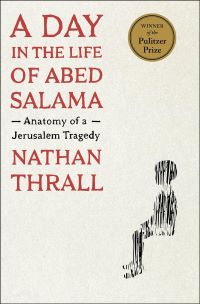
In case you missed the Pulitzer Prize announcements, General Nonfiction went to A Day in the Life of Abed Salama: Anatomy of a Jerusalem Tragedy. (Get the full list of winners.) It opens with the eponymous Abed running to the scene of an accident involving his five-year-old son’s school bus and a semitrailer on the outskirts of Jerusalem. What unfolds are the events of the crash on a wet highway, mis-steps by Israeli and Palestinian rescue response teams, and the restrictive walls and checkpoints causing confusion. I’m in the middle of reading the book, and fascinated by the concise, informative depth author Nathan Thrall weaves into the narrative concerning Jews and Palestinians living close together, their histories and land ownerships and conflicts.
Maps are provided to help us understand the West Bank, East and West Jerusalem, Palestinian and Jewish localities, plus more. Sometimes, it was hard for me to figure out the divisions separating the localities, how it all works, which has revealed a complexity I realize would take so much more than one book for me to understand. A Day in the Life of Abed Salama was written before the 2023 October 7 Hamas attack; it was published on October 3. As the book’s description says, the true story “unravels a tangle of lives, loves, enmities, and histories over the course of one revealing, heartbreaking day.”

Jayne Anne Phillips won the Pulitzer Prize in Fiction for her novel Night Watch, a family portrait set in 1874 in the aftermath of the American Civil War. A veteran delivers a daughter and her mother to an asylum in the Virginia mountains, where the story takes place. From the book’s description:
They get swept up in the life of the facility—the mysterious man they call the Night Watch; the orphan child called Weed; the fearsome woman who runs the kitchen; the remarkable doctor at the head of the institution.
Jayne Anne Phillips’ novel Machine Dreams has long been on my to-be-read list (it was published in the 1980s). Also, I’m wondering about Sweethearts, her first collection of short stories. Must go in search of that on the used book market, as it’s out of print.

I noticed Daunt Publishing in January is releasing Vivian Gornick’s 2015 memoir The Odd Woman and the City. Gornick won me long ago with her bold, fresh writing style and insight. Fierce Attachments, about Gornick’s relationship with her mother, and Approaching Eye Level, a collection of personal essays, are two of her books I’d recommend. This one I have yet to read. Here’s a bit from the book’s description:
Running steadily through the book is Vivian Gornick’s exchange of more than twenty years with Leonard, a gay man who is sophisticated about his own unhappiness, whose friendship has ‘shed more light on the mysterious nature of ordinary human relations than has any other intimacy’ she has known. The exchange between Gornick and Leonard acts as a Greek chorus to the main action of the narrator’s continual engagement on the street [in New York City] … In Leonard she sees herself reflected plain; out on the street she makes sense of what she sees.

Daunt is a UK publishing house whose dust jacket illustrations I often prefer to those of US editions. Comparing the two above, can you blame me? Alas, I already have the US edition of The Odd Woman and the City; however, I have my eye on Daunt’s editions of Natalia Ginzburg’s books for their more appealing cover art. Gornick and Ginzburg are authors I recommend, but the point here is more about dust jacket illustrations and the adage ‘you can’t judge a book by its cover.” Indeed, I’d say, here’s proof.

 The Longest Chapter
I hope Familiaris lives up to expectations and thanks for alerting me to the Gornick. I loved Fierce Attachments.
LikeLiked by 1 person
I adored Timbuktu. Could almost do with a reread!
LikeLiked by 1 person