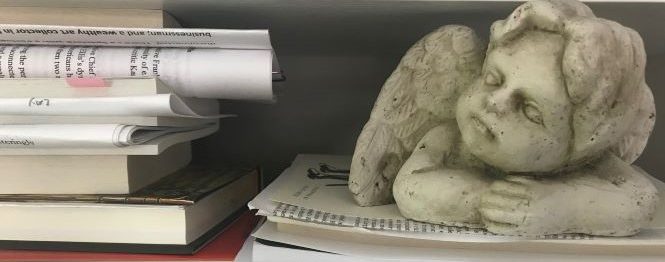
My Reading Table gets a make-over
February 27, 2010
A friend recently e-mailed me about a shake-up of her reading shelf. Her explanation for the change hit home, describing so well what can happen with a book that loses its glamour. She wrote: “I’ve been wading through my to-be-read shelves, moving out books that were a good idea at the time and starting [and then]discarding books that just aren’t worth the effort.”
And so, a reality check for My Reading Table, which I’ve been ignoring. Some of the books once were a good idea (Pete Dexter’s Paris Trout) and some aren’t worth the effort right now (Katherine Mansfield Notebooks: Complete Edition edited by Margaret Scott). They’ll likely get a spot on the table at another time, when the hunger for them returns. Meanwhile, my reading table now holds a smaller, more realistic stack of new and old books and will see action.
Below are the books moved off the reading table. They are now considered the “hopefuls,” among other unread books in my library.
- Along with Paris Trout, others once a good idea include Memoirs of Hadrian by Marguerite Yourcenar, The Rains Came: A Novel of Modern India by Louis Bromfield and Dracula by Bram Stoker, which hit the table during Halloween last year.
- Ulysses and Us: The Art of Everyday Living by Declan Kiberd, One Matchless Time: A Life of William Faulkner by Jay Parini, Loneliness as a Way of Life by Thomas Dunn and Prague in Danger: The Years of German Occupation, 1939-45 by Peter Demetz aren’t worth the effort right now.
- Parallel Play: Growing Up With Undiagnosed Asperger’s by Tim Page got returned unread to the lender, who wanted to lend it to someone else. I ran out of time.
- Too Much Happiness by Alice Munro, Generosity by Richard Powers, The Glass Room by Simon Mawer, and The Little Stranger by Sarah Waters are new books published in 2009 that I simply have to leave behind because there are — to paraphrase a popular saying, so many new books to consider in a year, so little time. They are all highly recommended. Ones to check out if you’re searching for a good book.
- About Grace by Anthony Doer and The Time Traveler’s Wife by Audrey Niffenegger are novels that need beach or patio time (i.e., undisturbed, long, warm sunny afternoons).
- For all the others, including Speak, Memory: An Autobiography Revisited by Vladimir Nabokov and 1940 by Jay Neugeboren, it’s just not a time.
Click on the photo above to get the list of books on My Reading Table, or go here.
Not your typical March Hare & Mad Hatter
February 20, 2010
I read Lewis Carroll’s Alice’s Adventures in Wonderland at an awkward age when I was too old to appreciate the nonsense and too young to get it. A Mad Hatter’s tea party? A caucus race that runs in circles? It annoyed more than entertained me those many years ago. But Jamison Odone’s whimsical and brief retelling of this 1865 classic, Stickfiguratively Speaking: Alice’s Adventures in Wonderland, gave me a chance to revisit the nonsense.
This time I had great fun, thanks to Odone’s quirky interpretations. Indeed, I carried the book around with me — small enough to fit in my purse and winter coat pocket — and randomly read and flipped through the pages over and over again, each time seeing something new.
Odone says in a press release, “There is really no room for the words to carry the art or vice versa—they have to all work together.” With that, he succeeds, playfully interchanging words and illustrations on the pages. Adding surprise and humor, the interior thoughts and snarky side comments of Alice, the White Rabbit, the Mad Hatter and other characters spice up the familiar oddness. To get an idea of the stick-figure style, check out Odone’s blog post Alice’s Adventures in my pad.
Odone will produce more Stickfiguratively Speaking books. The next one in the series, scheduled to be published in September 2010, is Stickfiguratively Speaking: The Legend of Sleepy Hollow.
On a final note, the release date for Stickfiguratively Speaking: Alice’s Adventures in Wonderland is March 5, the same day Tim Burton’s movie Alice in Wonderland appears in theaters. A variation on the classic, the movie imagines 19-year-old Alice returning to a Wonderland ruled by the irrational “off with their heads!” Red Queen. Reading the former before seeing the latter is a great way to be reacquainted with the classic characters and their bizarre ways.
Risky poetry purchases
February 15, 2010
So many times I buy a new book of poetry only to find I don’t relate to or understand the poems. The collection may be award-winning and acclaimed by critics but, for me, reading the verses feels like chewing wood. Case in point is Chronic by D. A. Powell.
It’s a finalist for the 2009 National Book Critics Circle Award for poetry. Also, a few weeks ago, it won the prestigious $100,000 Kingsley Tufts Poetry Award. That got my attention. Then I read the following about Powell from a 2001 poetry award, and I eagerly drove to The Book Loft to buy Chronic, Powell’s newest and fourth collection of poems.
“His seems a vision born less of suffering than of an understanding of suffering’s place within the natural order, and the result is a voice that can say, believably, ‘the way to haven seems interminable,’ that can knowingly ask ‘am I not dust?’—without seeming to seek pity.”
You probably know where this is going. Ten poems into Chronic I put it aside unmoved. One more book on the poetry shelf that’s not read, sitting beside many of my favorites, ranging from the keenly observant Mary Oliver and Liesel Mueller to the raw offerings of Charles Bukowski and Diane Wakoski.
When I called The Book Loft to find out if they had Chronic in stock, the clerk casually commented — I assumed he was reading his computer screen of inventory — they had one copy that was received in May. That would’ve been 2009 because Chronic was published in February 2009. This told me the book sat on the shelf for ten months until I came along. (The mega-bookstores in town didn’t have Chronic in stock.) And here’s what this all adds up to: People don’t buy poetry like they buy novels or memoirs and because of that bookstores don’t keep a wide selection of new poetry by up-and-coming poets or mid-career poets or established-but-not-popular poets in stock and because of that we don’t have the opportunity to browse for new poetry or discover new poets and make more successful purchases.
I usually read about poetry books and then order them online with my fingers crossed because I assume, from experience, they’re not available at a local store. Chronic was an exception. In hindsight, I should’ve snuck away to a corner and read some of the poems before I opened my wallet.
Maybe it’s a good thing the poets I don’t understand hold space in my library. Tastes change over a lifetime. Someday I may reach for and enjoy them, and then the money won’t have been spent in vain. That’s how I’m choosing to think about Chronic and similar poetry disconnects on my bookshelf. And as I continue to take my chances, I’ll sigh: Oh for bookstores in our cities like The Grolier Poetry Bookshop. Oh for a time when such bookshops could and would thrive everywhere.
Note: This post was updated later in the day, after publication. It was updated again, 3/7/10, correcting 2010 National Book Critics Circle Award for poetry to 2009.
Webster is fine now (thank you)
February 12, 2010
This snowy winter, one of my two corgis got sick. The whites of his eyes became red and, when a visit to the vet and several rounds of eye drops didn’t change anything, off we went to MedVet. Four hours, an opthalmologist and a neurologist visit later, I learned Webster has an autoimmune condition. The good news is we caught it early and he’s going to be fine.
Obviously, this post has nothing to do with books, other than the fact Webster is named for a dictionary. It’s a thank you to those who’ve known about Webster’s situation and asked about him. As dog owners in the MedVet lobby with their newfies, bulldogs, basset hounds, golden retrievers and assortment of mutts said, these four-legged personable creatures are family. Dog owners everywhere get that. Just as book owners everywhere get the companionship of books.
My other corgi appeared on TLC last fall in “The dog ate it (really)”. I updated the photo on the post. (I should’ve named her Merriam.)
A big, new novel about the Vietnam War
February 9, 2010
The New York Times featured an article yesterday about U. S. soldiers writing memoirs on their war experiences in Iraq and Afghanistan. “So far there are relatively few novels” about the current wars, the article said. It attributed the fictional dearth to soldiers needing “more time to explore ‘what happened inside,’” according to Tim O’Brien, who’s written both memoirs and novels about his Vietnam war experience. (Going after Cacciato won the 1979 National Book Award in fiction.)
A case in point is ex-marine Karl Marlantes’ novel Matterhorn to be published in April. This 700-page Vietnam epic took 30 years to write. When it was completed, the author couldn’t find an agent or publisher until El León Literary Arts, a small publishing house in Berkeley, saw its merits and planned to publish it . The book was printed, review copies were mailed, and then interested New York publishing houses started calling El León’s editor-in-chief Thomas Farber. That’s how the small publishing house came to join forces with New York publishing house Grove/Atlantic in getting Matterhorn to readers.
The author Marlantes earned several military medals, including the Navy Cross for extraordinary heroism. He joined the Marines after high school, but he got into Yale and so went to college first. Then he received a Rhodes Scholarship. Although the military continued to give him a leave of absence to attend school, he felt he was hiding behind privilege at Oxford, according to The Oregonian, and walked away: “He was in Morocco, living — drifting, really — off his Oxford scholarship funds when his duty became clear. He showed up at a U.S. naval base in yellow curls and a djellaba, smelling like a camel, and announced, ‘I’m 2nd Lt. Marlantes.’” Marlantes went to Vietnam in 1968.
Publisher’s Weekly gave Matterhorn a starred review saying, “…he brings a long, torturous war back to life with realistic characters and authentic, thrilling combat sequences.” Library Journal also gave it a starred review with this caution, “Obviously not a brief, cheery read…”
It was a long and snowy journey
February 6, 2010
Considering the current weather, what Facebook friends in the D.C. area are calling a “snowpocalypse,” historian Michael O’Brien’s new book seems appropriate. Mrs. Adams in Winter: A Journey in the Last Days of Napoleon tells the story of this future American First Lady’s winter journey from St. Petersburg to Paris in 1815. Library Journal gave it a starred review, describing the book as “witty, informed, sophisticated, and moving.”
LJ interviewed the author, who said he was “drawn by the literary challenge of narrating a journey and a biography simultaneously. As for my readers, if they come away with a sense of who Louisa Adams was, as well as a sense that the United States and Europe were then intermingled but diverse worlds, I would be content.” More of that interview here.
According to the publisher’s summary, Louisa Catherine Adams traveled through the snows of eastern Europe, down the Baltic coast to Prussia, across the battlefields of Germany and into Napoleonic France. “An evocative history of the experience of travel in the days of carriages and kings, Mrs. Adams in Winter offers a moving portrait of a lady, her difficult marriage, and her conflicted sense of what it meant to be a woman caught between worlds.”
A book to anticipate – Mrs. Adams in Winter is scheduled to be published in early March.
Trial lawyer walking
February 2, 2010
Joshua Ferris’ first novel was laugh-out-loud funny, let alone a perfect cynical take on the downsizing of corporate America. I eagerly anticipated his second novel, and I wasn’t disappointed. Still, I don’t think it’s for every reader. The Unnamed explores an interesting premise of how sickness can ruin a life, and it’s captivating for its inventiveness. But it’s not an involving story because we’re not called to care about what’s going on, only to observe it.
The protagonist is a successful Manhattan trial lawyer, Tim Farnsworth, suffering from a bizarre condition of involuntary walking. His feet mechanically march him through city streets, across bridges, along highways and through good and bad neighborhoods without letting him stop. Twice this condition kidnaps Tim in the middle of his life and twice he goes into remission. Each time he successfully hides the weirdness from his fellow law partners by taking time off with fake excuses about his wife’s health. When the novel opens, the condition has returned a third time. The reality hits hard. With the medical community stumped and no treatment or cure available, Tim and his wife know their lives will forever be held hostage.
While this is a dramatically tragic plotline, Ferris keeps us above compassion by writing to the situation’s insanity. For example, Tim carries a survival back pack wherever he goes at the office because he could start walking at any moment. Also, as a test procedure — their last hope, actually – a doctor prescribes the daily wear of a helmet wired to capture brain activity. And Tim’s every walk ends with a tidal wave of exhaustion dropping him into a deep sleep in odd locations. One time it’s in the cab of a potato chip truck.
No longer wanting to burden his family, Tim eventually surrenders to the condition and takes off across the United States, willingly walking himself into physical and mental ruin. His endless motion becomes as relentless in the reading as the walking itself, but Ferris nevertheless keeps us traveling with his protagonist by fueling us with fresh prose. In the end, Tim learns his wife is battling cancer, and he walks home from the West Coast to be with her. Of any emotion in this unique and very sad story, it is their spousal romance that creates spark and purpose amidst all that doesn’t make sense.
Richard Bausch

