
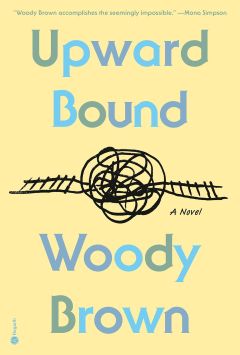
Upward Bound is a fictional daycare program where the majority of the participants are nonspeaking, autistic young adults. It’s located in Los Angeles, inside an eighties-era building with old school linoleum and accordion dividers. It’s a dead-end way station, according to Walter. He’s one of the nonspeaking, autistic clients, although with a pinch of wit, he often refers to himself and his peers as inmates. He’s a vibrant narrator who pops in with irreverent truths and arresting insights.
Walter’s been homeschooled by a mother determined to give him the education he deserves. She teaches him to communicate by pointing at a letter board. He graduated from a community college, his mother attending classes alongside him with the letter board. Then family circumstances led to his mother needing to return to full-time work. There was no option other than Upward Bound for Walter during the day.
Walter opens this trailblazing debut with a situation in which the staff isn’t paying attention in the rec room when his friend Jorge leaves the building. Jorge’s a nonspeaking, autistic eloper, frequently wandering away from the group. It’s not to escape. He’s going toward something that’s obvious only to Jorge. Walter can’t express himself in a way that signals Jorge’s disappearance, so he follows Jorge. He finds him on a grassy area near the parking lot, tucked inside a terra-cotta tunnel where it’s cool and quiet. Walter sits on a nearby bench, waiting for a staffer to come looking for them. Eventually, the two are found, and they’re reprimanded by the Upward Bound director for doing something dangerous and thoughtless. An incident report is written. We feel and see what it’s like: Walter’s frustration of not being able to speak up in self-defense before the heartless, inexperienced director.
Upward Bound reads like a collection of linked stories. It moves through chapters told in multiple viewpoints that illuminate the clients’ interior lives. The results are eye-opening. There’s Tom, a handsome young man with cerebral palsy. He’s trapped inside his rigid body, but he hears and understands everything. And there’s Emma, who’s calm and withdrawn, but Walter standing beside her can hear Emma’s thrumming anxiety. Among the staff, there’s reliable Carlos and perceptive Ann. She’s new, working at Upward Bound during her summer college break.
Every Friday morning the staff take the clients on a field trip to Target. It’s intended to desensitize them to the chaotic everyday consumer world. Ann one morning goes in search of Jorge, who’s predictably done a runner. She’s pushing Tom in his wheelchair, and with racing speed, she takes him on a joyride, jumping on the back of the chair, and soaring down the empty aisles. In another uplifting scene, quiet Emma puts her hands on her head, indicating to Ann she wants her hair done in a French braid, the way Ann does her hair. Ann doesn’t understand what Emma wants. When finally she does, it’s a powerful turning point and the key to what this novel is about.
They, the disabled, were not the other. I was the other, and they had let me in.”
Occasional brilliance in the writing showcases the talent of the author Woody Brown. An example is how he describes the repetitive words that spew uncontrollably from the client Drew. His ability to speak, we’re told, is not a superpower at Upward Bound but his kryptonite. Another is when the gentle giant Jorge, sitting in the shade under a little kids’ play structure, is described as “a giant egg nesting in wood chips and fiberglass.”
This is a story about how the disabled are overlooked and underestimated. How they are spoken to not with. How they are given infantile activities, when they want to be productive. It’s a moving depiction, and literature that, given the authenticity that registers from page one, feels revolutionary. The author Woody Brown is himself autistic and nonspeaking. I often wondered if the fictional Walter channeled Mr. Brown, especially when Walter says:
The story of my people isn’t being told, or it’s being told wrong.
A difficult conclusion involves Jorge once again wandering out of the Upward Bound building. Also, there’s a new routine at home for Walter with his mother. He’s reading books, and writing his memories. Walter thinks maybe he’ll keep writing and see what happens. Let’s hope he does.
Upward Bound by Woody Brown is published by Hogarth. This review aired on NPR member station WOSU broadcasting in Central Ohio. Edits, with the expansion of scenes and the addition of quoted material, were made in the transition from radio to print.

 The Longest Chapter