
I received an email from Dan Wells, publisher and founder of the independent press Biblioasis, whose books I’ve read and reviewed for many years. He wanted to call to my attention a new short story collection in this fall’s line-up. Dan often sends notes about their new books, but this one was different. It shared a personal experience. I don’t think he’ll mind me sharing it here:
I first came across Caroline Adderson’s work in university when I picked out her debut collection of stories, Bad Imaginings, as partial payment for spending the day cleaning a used bookstore’s disgusting carpets: it proved to be more than worth the eight hours I toiled in that place, trying to figure out how the experience would make me a bookseller (I actually understand now). I’ve been a fan of Adderson’s ever since, especially of her short fiction…
I could just imagine that bookstore scene, the feeling of discovering one special book as reward in the middle of hard, tedious work. How could I resist?
I didn’t start the collection by reading the first story, rather I randomly opened to one in the middle. A Russian hit man is given a new assignment. He flies to the destination while making covert stops in between. He suffers from a critical lung condition, but more insistent than either of these situations is a childhood memory. The plot is the only one in this collection with a hint of darkness. It’s not too dark, though, rather surprising and moving for how the man comes to feel hope within the grip of evil via a stranger’s kind and safe human touch.
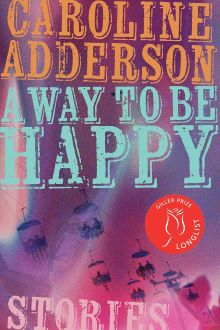
The eight stories in A Way to Be Happy vary in circumstance and with equal narrative strength. It’s an impressive collection for how Adderson thematically connects the stories by happiness – sometimes as a brief glimpse, sometimes as an insight that becomes an interior anchor. It typically arrives by means of a human encounter, with the possibility of being life-changing. It’s an illumination that brings comfort and self-awareness, which relate to feelings of belonging. The characters know, in what they’ve experienced from the encounter, this is how it feels to be cared for, or to make a difference, or to cherish what we already have, all pathways to living in contentment, to being happy.
In a particularly touching story, two drug addicts rob a high-end New Years Eve party. They merge into the crowded condominium as if they belong, Taryn tasked with the theft while Cory socializes. But there’s a woman nursing a baby in the dark bedroom where the coats and purses have been thrown. Taryn returns later to do the stealing, while the mother is gone and the baby sleeps. She’s almost caught, except the man thinks she’s leaving the party early. Taryn whispers to him and points at the crib. It’s such a simple action, when she touches the baby and feels the sweetness and warmth, and yet powerful for the rush of joyful relief it provides, similar to when she was rescued from an overdose by a paramedic.
That same profound simplicity happens in another story when a woman believes a man in an old Chevy truck is stalking her: at the schoolyard fence when she picks up her son, on a dog walk, and working in the garden with her wife. She feels his menacing presence, but the story turns gracefully on a connection that would be obvious, if she weren’t blinded by her anti-social behavior. It’s so well done; I didn’t see it coming.
It’s difficult to make happiness interesting. Caroline Adderson, however, succeeds with stylish skill. She creates sympathetic characters struggling with inner complexities – what it feels like to be a disappointment, or to not be believed, or to lead a passionless life; always offering, though, an encounter providing a respite from loneliness or isolation.
In a story called “Homing,” 62-year-old Marta moves to a remote town after separating from her husband. Her need for the break lacks a specific reason, which makes it incomprehensible to him. Now she’s in a situation where her neighbors ignore her. When her husband calls, she tries not to break down.
How to explain the contradiction of her loneliness when she’d been the one to leave?
One day, banded homing pigeons mysteriously congregate on Marta’s rented property. Here’s where the unexpected happens.
The Russian hit man, in the first story I mentioned, remembers something his grandmother said: “The people who come a hundred years, or a couple of hundred years after us? They’ll despise us for having lived so stupidly. Perhaps they’ll find a way to be happy.” She’s paraphrasing lines from Anton Chekov’s play Uncle Vanya. The full quote appears at the front of the book, but it’s this part that gives notice these marvelous stories are here to turn on headlights.
A Way to Be Happy: Stories by Caroline Adderson is published by Biblioasis. A version of this review appeared on NPR member station WOSU 89.7 FM, which broadcasts throughout central Ohio.

 The Longest Chapter
2 thoughts on “Caroline Adderson’s “A Way to Be Happy””