Life would be perfect if …
May 31, 2010
In her amusing new memoir, Meghan Daum says she moved 18 times in 15 years. Her addresses changed from New York City apartments to Nebraska farmhouses to Los Angeles rental homes. She writes in the prologue that we’re about to find out what happens when identity becomes almost totally wrapped up in where you live. (In a snapshot, if you’re not planning to move, then you’re moving.) It’s an obsession for Daum that believes a fresh start comes with a new home. Fueling this obsession is her splintered self-image, one as a Carrie Bradshaw city girl à la Sex in the City, the other as a wilderness girl à la Maggie O’Connell in Northern Exposure.
Daum’s many moves at first seem acceptable for an energetic young Gen Xer, perhaps excessive yet understandable due to location or landlord or roommate issues in New York City. Her relocation to Lincoln, Nebraska, where she rents a farmhouse with a boyfriend for two years, even seems OK. But then the insanity kicks in. Daum leaves Lincoln to settle in Los Angeles. She’s actually driving out of town for the last time and makes a quick detour to look longingly at a farmhouse that’s for sale. She gets to L.A. and convinces herself she can rent in L.A. and own the adored farmhouse in Lincoln. The seller, however, refuses her offer that’s above the asking price (she’s nuts to think she can manage the farm). Daum ends up purchasing another Lincoln farmhouse, which she ditches before the closing, realizing she’s not the wilderness girl she wants to be.
Daum’s writing style is breezy, witty and lively while describing how she moves into dwellings that are perfect for what she imagines for herself but in reality uninhabitable (such as the brown water coming from the faucets in the farmhouse). Indeed, Daum is delightful reading company. So much so that it’s easy to overlook two minor problems. She neither goes into detail about how she finances her moves nor shares how she tolerates hauling her belongings from one place to the next. And yet those are the two things that come to mind for everyone who’s struggled to come up with a security deposit or down payment, let alone moved a sleeper sofa or a library of books.
Daum lives in so many rental houses in L.A. I couldn’t keep them straight. Eventually, she buys a 900-square-foot problem-ridden bungalow that demands she look at her commitment-phobic, self-image problem. Life Would Be Perfect If I Lived In That House concludes with a satisfying transformation; however, despite the clever, entertaining writing, I don’t think Daum’s story requires the length of a book to reach this point. A long New Yorker essay would have been just as satisfying. Still, Daum’s humorous view on life makes you want to spend time with her, no matter what form her writing takes.
Once lost, now the 1970 winner is found
May 26, 2010
The announcement date, May 19, came and went, and I forgot to follow up on the Lost Man Booker Prize. So here it is, the winner, announced last week: Troubles by J. G. Farrell, the first book in his Empire Trilogy published in 1970 that’s followed by The Siege of Krishnapur (which won the Booker Prize in 1973) and The Singapore Grip (published in 1978).
Troubles takes place in Ireland and tells the story of a military major who returns from the Great War to find his Anglo-Irish fiancée and her family owned hotel greatly changed. According to The Guardian’s Books Blog: “Farrell’s portrayal of the fast-decaying Majestic Hotel and England’s even more rapidly crumbling rule in Ireland surely adds up to one of the best books of the last half-century, let alone 1970.”
Troubles received more than double the votes cast for the other books on the Lost Man Booker shortlist. You can read about the how and why of this delayed prize in TLC’s 1970 novel to get award in 2010. There, also, you’ll get the five contenders that lost. In essence, the Man Booker Prize didn’t get awarded in 1970 due to a change in the time of year for the prize announcement. Man Booker management decided to correct the oversight and fill the gap.
In a Times Online review of Farrell’s Selected Letters and Diaries edited by Lavinia Greacen (who also wrote his biography,) Troubles was a critical success but a commercial flop when it was released, selling less than 2,000 copies. The second and third books in the trilogy secured Farrell’s success. He became known for insightful fiction on the topic of British colonialism.
Farrell died at the age of 44 in 1979. He was fishing beside the sea near his farmhouse in southwest Ireland when waves knocked him off the rock into the water, and he drowned. He was at the height of his writing career. The tragedy shocked Britain’s literary community.
The aforementioned letters and biography about J. G. Farrell are:
Vampire booze
May 16, 2010
Little Vampire Women hit bookstores this month, another one of those mash-ups of a classic, this one penned by Lynn Messina. I’m not going to bark and whine my reason for not reading it, like I’ve done about Seth Grahame-Smith’s mash-up of Austen’s Pride and Prejudice. My resistance is old news. I just want to use the idea of the demon March sisters as an introduction for admitting I tried to read Abraham Lincoln: Vampire Hunter, currently a New York Times best-seller, and can’t get myself to finish it. I’m bored.
As Grahame-Smith recounts Lincoln’s life, he inserts the presence and influence of vampires into events. In other words, we learn Lincoln’s father was killed by Shawnee Indians when plowing his fields and his mother and her great-aunt and great-uncle died from a fatal illness but — hold on — later it’s revealed they really died at the hands of a vampire. And those slaves in leg-irons trying to take Lincoln’s boat on the Mississippi? They don’t have a plantation owner on their heels. They’re running from a vampire.
In the spring issue of N+1, UCLA professor Mark McGurl discusses the current zombie literary craze in “The Zombie Renaissance.” Regarding Grahame-Smith’s mash-up efforts in Pride and Prejudice and Zombies, McGurl supports my aforementioned point when he writes, “…Grahame-Smith merely tacks the equivalent of ‘and zombies’ onto various parts of Austen’s public domain text and calls it a day.”
McGurl delves into the ‘why’ of the “strangely appealing” zombie phenomenon in books not only concerning the Austen mash-up but also Max Brooks’ The Zombie Survival Guide and World War Z. He explores the philosophical zombie and the plodding zombie, and I like his thoughts about allegory. I also like his reference of the mash-up as “a sort of Trojan horse” gaining entry to great literature. I’ve thought of it in less esoteric terms, as the booze that makes a cumbersome party fun.
I watched a YouTube video of John Matteson, Louisa May Alcott’s Pulitzer Prize winning biographer, moderating a discussion about Little Women mash-ups in “Monster Throwdown: Vampires, Werewolves and Louisa May Alcott.” Here I learned Alcott wasn’t averse to ghoulishness, having written “blood and thunder tales” under a pseudonym.
Matteson plays a game with the audience called Alcott or Faux-cott in which he reads selections from Alcott’s scary tales interspersed with selections from mash-ups, including Porter Grand’s Little Women and Werewolves also published this month, to find out if the audience can distinguish between the two. (See for yourself. The style nuances and some of the words give it away.)
So here I am rambling about essays and videos about zombies and vampires that help define this popular literary trend. Meanwhile my bookmark is stuck at page 145 (out of 336 pages) in Abraham Lincoln: Vampire Hunter. I nag myself to finish the darn thing, but I just can’t bring myself to do it. I keep picking up another book. I guess the “and vampires” booze doesn’t give me a buzz, even though everyone else at this Lincoln party is having a blast.
My ADD book collecting habit
May 6, 2010
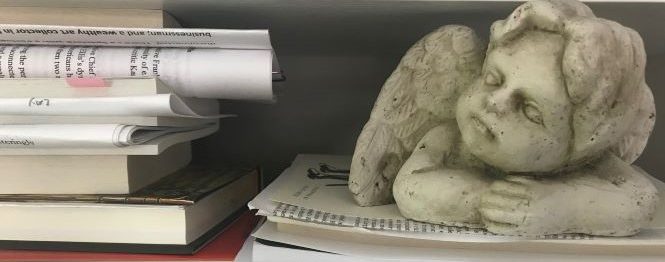
I’ll be moderating a panel about book collecting this weekend. The preparation has led me to consider my own book collecting habit, and I wonder if I’m expressing attention deficit disorder in that area of my life. It all began when I decided to collect William Faulkner, but as you can imagine, first editions of his books are pricey, so I took the tack of “what I can afford” Faulkner. That means I own a first edition of The Sound and the Fury in spanish, published in Buenos Aires. At least, I think it’s a first. I stopped collecting Faulkner and began collecting Katherine Anne Porter for a while, and then Thomas Pynchon and Shirley Jackson. Oh, and Louis Bromfield, William Styron, Andre Dubus and James Salter. There are also first edition paperbacks of Ian Fleming’s James Bond novels on my bookshelves as well as my Perry Mason collection.
I envy “completists,” who focus on one author or idea, because I think they’ll end up with collections worthy of a library installation or a great sum of money. A few years ago, I was on a bus with collectors touring libraries in Washington D.C. Everyone introduced themselves and what they collect. Their answers were so very neat and tidy. The journals of Arctic explorers. Miniature Bibles. Books published by Thomas B. Mosher. Alphabet books for children pre-20th Century. My thoughts scurried about as to what I could say. “I seem to like everything” didn’t sound very sophisticated. Someone before me said he collected modern firsts, so I used that. It was close enough. Nobody needed to know about my erratic collecting of bird books.
Here’s something else. I find myself buying the odd one-offs. Books that fit nowhere into any of my collections. Like, The Second Funeral of Napoleon in Three Letters to Miss Smith of London and The Chronicle of the Drum published in 1841. William Makepeace Thackeray penned it using Michael Angelo Titmarch as his nom-de-plum. Then there’s this $75 paperback, WeeGee’s Naked City. What attracted me was the blurb on the cover: “Weegee photographs that O. Henry might have done if he had worked with a camera.”
Obviously, I don’t complete, I don’t focus and I can’t afford the top ticket items that would make my collections worthy of a bus announcement, but book collecting is a thrill for me. Everything – from the search to the surprise-find, from roadtrips to attend book festivals to borrowing from the house maintenance budget to pay for a must-have — figures into that thrill. And I’ve learned along the way, something I hope the panel communicates to our audience, there are all kinds of ways to collect, and all kinds of collections. Neatly packaged and defined is not a requirement.
This post was updated 10.17.10 with improved images of the books.
Is Rusty Sabich innocent again?
May 2, 2010
This week, the sequel to Scott Turow’s 1987 blockbuster Presumed Innocent will be on bookstore shelves. Rozat “Rusty” Sabich, the deputy prosecutor of Kindle County, returns in Innocent as chief judge of the state appellate court. He’s 60-years-old now and campaigning for a position on the state supreme court. He’s also still seeding trouble for himself in an extra-marital affair, trouble that once again lands him on trial for murder. Not for killing his mistress, as it happened in Presumed Innocent, rather his wife, Barbara.
Such an idiot, I kept thinking in the first half of the book. How can this intelligent attorney be so blind as to think he can get away with sneaking in and out of hotels with his young law clerk months before an election day with his name on the ballot? It’s cringing to observe his weakness, yet his affair with Anna and his stupidity are an integral part of the plot’s well-wrought tension. Even after Rusty ends the affair, it hovers ominously when Rusty’s son Nat, also an attorney, pursues Anna for romance.
Nat doesn’t know about his father’s brief tryst with Anna, and he’s perplexed by her resistance when they’re clearly drawn to one another. Eventually the two get involved, and Barbara invites the couple for dinner at the Sabich house. The day after the get-together, she doesn’t wake up from her night’s sleep. Barbara’s death is ruled to be from natural causes, but the fact Rusty doesn’t call the police for 24 hours creates suspicion. More incriminating evidence rolls into the prosecuting attorney’s office, and Rusty is charged with murder.
There’s long history between Rusty and Acting Prosecuting Attorney Tommy Molto from Presumed Innocent, which complicates the accusation. Turow seamlessly revisits and summarizes this past, as well as other significant events from the first novel. I haven’t read Presumed Innocent, nor have I seen the movie with Harrison Ford, yet never for a moment did my voracious reading stumble because I didn’t recognize something from that past.
Surprising developments during the trial kept me on edge. This is courtroom drama at its intricately constructed best. Turow, however, does more than spin complex, entertaining legal scenes. He creates characters we care about. I got as involved in the personal stakes and emotions of the cast as I did with how the murder would be resolved, to the extreme that I put down Innocent within 100 pages of the last page and began reading another book. I thought it was strange behavior, considering I was absorbed by Innocent, until I realized I wasn’t ready to leave Rusty, Nat, Tommy and the others, as they sparred in court and then went back to their offices to talk about what happened.
A mere chapter into the other book, and I was hurrying back to Innocent. I needed to find out if my guesses about “who killed Barbara” would be right. (They weren’t.) Of course, I gave in to reaching the end, and I arrived satisfied and breathless. Tommy Molto says at one point, “This trial is a runaway. Nobody knows what happens next.” That’s in fact what makes Turow’s Innocent so exhilarating. You just don’t know for sure until the end.


